German-type Italianer chickens: eggs, temperament, size and Leghorn differences
 Piotr Markotpoultry keeperFor backyard keepers and small flocks
Updated:
An Italianer can find the best insect before the keeper has opened the feed bin. Here is how productive the breed really is, how to recognise it and why the name should not simply be replaced with Leghorn.
Where did this breed originate?
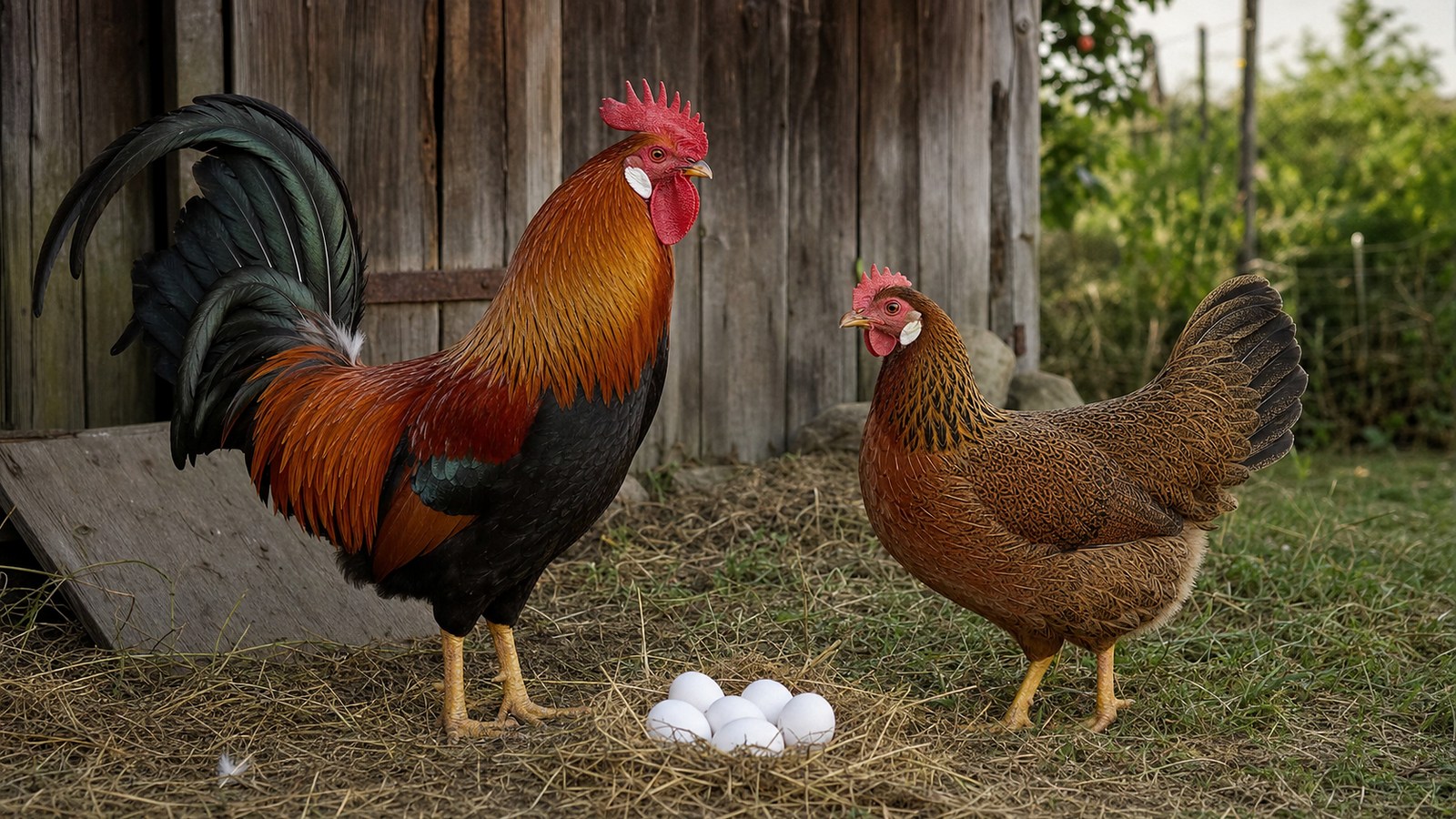
The Italianer traces its roots to Italian farm chickens, with later breeding in Germany shaping a type governed by its own standard. It shares Italian ancestry with the Leghorn, but the names should not be used interchangeably. Confirm the breed and standard of the parents before buying.
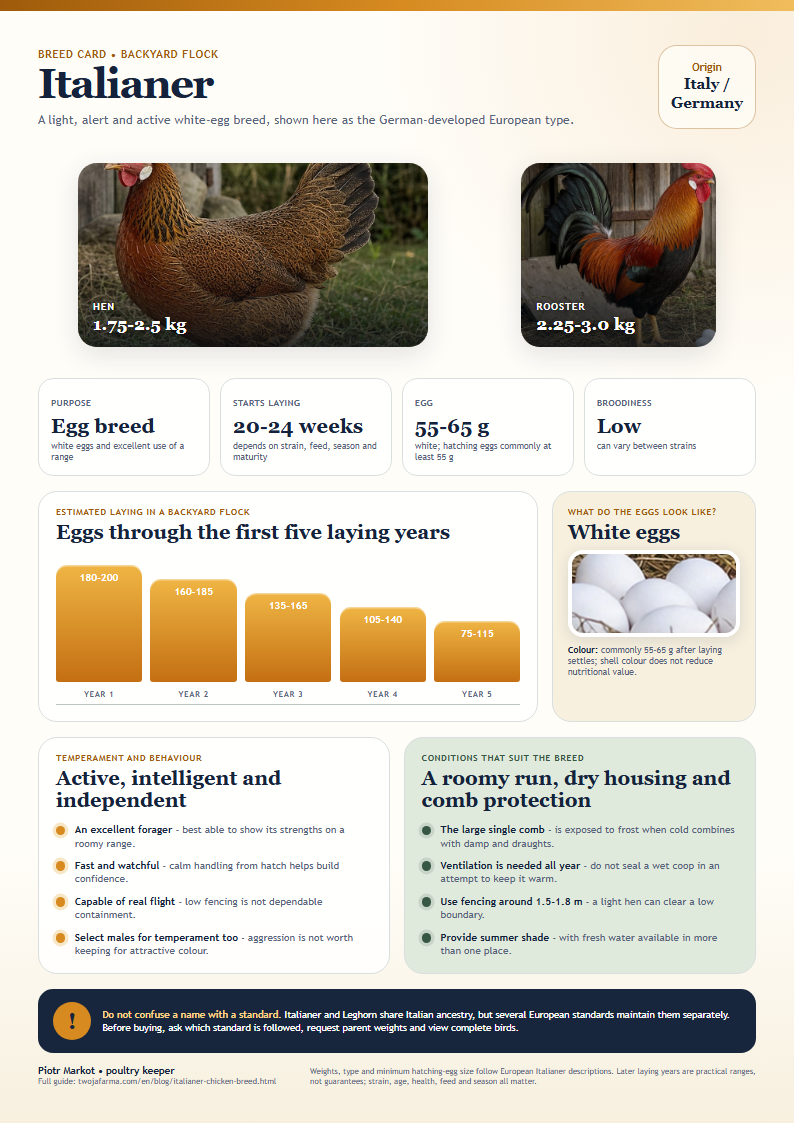
Printable Italianer breed card
Adult weights, white eggs, temperament, housing needs and practical five-year laying ranges are collected on one printable A4 page.
The short answer: a light, active and genuinely useful white-egg layer
The German-type Italianer is not a chicken that waits beside the feeder all day. It is alert, quick and naturally interested in finding food around a run. A useful hen can produce roughly 180-200 white eggs in her first full laying year while remaining lighter and more economical than a heavy dual-purpose breed. She also notices an open gate long before the keeper does.
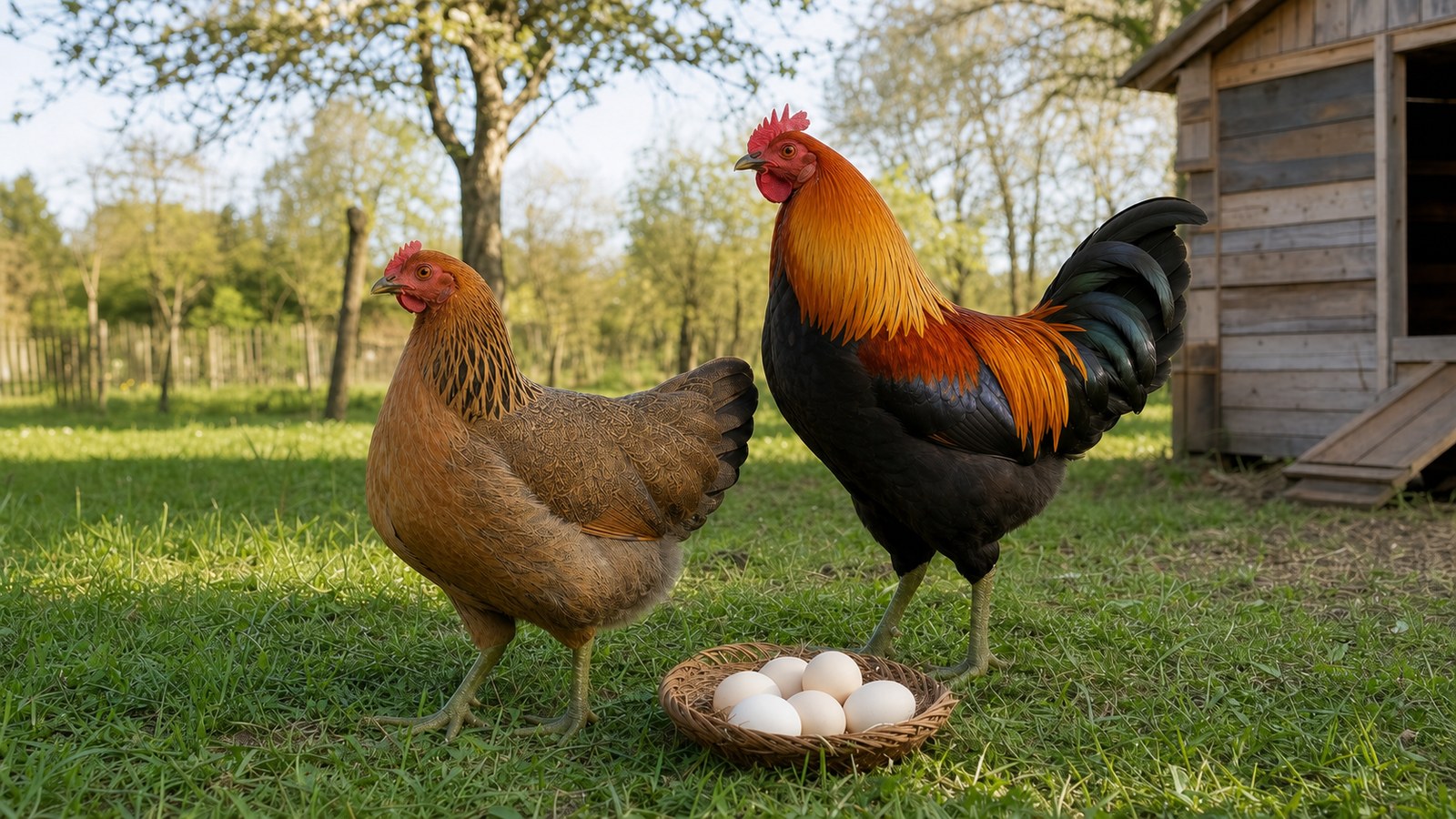
The Partridge variety shows the breed particularly well. The male carries orange-red hackles and saddle feathers, a dark breast and a glossy black-green tail. The hen is much quieter in colour, with fine brown pencilling that provides useful camouflage. The contrast is normal sexual dimorphism, not a sign that the female has inferior markings.
This is not a breed for every garden. A bare little pen gives such an active bird very little to do, a low fence may be treated as a suggestion, and the large single comb needs attention in severe winter weather. For a keeper who wants white eggs, efficient foraging and chickens that make real use of a spacious run, however, the Italianer deserves much more attention.
Italianer facts: adult weight, eggs and practical characteristics
European descriptions commonly place hens around 1.75-2.5 kg and males around 2.25-3.0 kg. A much heavier, very square and slow bird may be a cross or a line selected to another type. An extremely small hen is not automatically a better layer either. Proportion, condition and the breeder's selection records matter more than one number on a scale.
| Feature | Practical range | What it means in a backyard flock |
|---|---|---|
| Hen weight | about 1.75-2.5 kg | light and mobile rather than broad and heavy |
| Cock weight | about 2.25-3.0 kg | clearly larger than a hen but still agile outdoors |
| Point of lay | usually 20-24 weeks | an autumn hatch or slower strain may start later |
| First full year | about 180-200 eggs | a utility strain may outperform a strongly exhibition-bred line |
| Eggs | white, commonly 55-65 g | hatching eggs should be sound in shape and around 55 g or heavier |
| Temperament | active and watchful | excellent range use, but fencing and space matter |
| Comb | large single comb | more exposed to frost than a rose or pea comb |
| Broodiness | usually low or strain-dependent | do not assume every hen will hatch chicks naturally |
Italianer and Leghorn: close relatives, but not automatically the same breed
This is where naming becomes awkward. The German-type Italianer was developed from chickens of Italian origin and selected in German-speaking Europe into a defined exhibition and utility type. The Leghorn also descends from Italian stock, and its name comes from the English form of Livorno. Their shared roots explain the resemblance, but they do not make every Italianer a Leghorn.
German and several other European systems maintain separate standards and specialist clubs for Italianer and Leghorn. Polish research papers also list Włoszka, the Polish name for Italianer, separately from Leghorn populations. French terminology is less tidy because the German type may be described as Italienne or Leghorn moderne. Anyone importing birds or eggs should therefore ask which written standard the breeder follows and request full side-on photographs of the parents.
In practical terms, the Leghorn is often associated with a more extreme light-layer shape and very strong selection for egg output. The German Italianer remains slim and active but generally carries a little more body and has been developed in numerous precisely described colour varieties. Old backyard lines can sit between textbook types, so examining the actual flock is more useful than arguing over a sales label.
How to recognise a sound German-type Italianer
A sound Italianer is medium-sized, elongated and elegant without looking weak. The body is fairly long, the breast rounded and the back rises gently towards a well-developed tail. A laying hen needs a deep enough abdomen for useful production. The wings sit close to the body. Shanks are yellow, clean and unfeathered, with four toes on each foot.
The head is immediately noticeable. A male carries a large, upright single comb with regular points. In a mature hen, the rear of the comb may fall neatly to one side while the front remains clear of the eye. The face and wattles are red; the earlobes are white or creamy white. White earlobes and white eggs are familiar traits among several Mediterranean-derived breeds.
A pullet photograph cannot show every mature feature, so ask for current pictures of both parents standing naturally. Check leg colour, earlobes, comb type, straight breastbone and sound toes. Avoid birds with persistent eye closure, nasal discharge, noisy breathing, severely pale combs in season, crooked toes or lifted leg scales. A good colour pattern cannot compensate for poor health and structure.
Partridge is only one of the Italianer's colour varieties
Partridge is the variety many Central European keepers know best. The hen blends naturally into a run while the male is highly decorative. Depending on the national standard, breeders also keep Silver, Black, White, Blue, Orange-necked and other carefully defined varieties. Recognition lists differ between countries, so a colour accepted at one national show may have another status elsewhere.
Colour must not hide the underlying bird. Perfect pencilling on a narrow, unhealthy hen with weak legs is a poor foundation. A practical backyard bird with a small exhibition fault may be far more valuable when she remains healthy and lays reliably. Tell the breeder whether the aim is showing, establishing a breeding pen or simply keeping sound pure-bred layers.
Do not mix varieties casually. Silver and gold genetics can be used deliberately because the silver factor is sex-linked, but the result is not a simple promise of two correct colours from one mating. Blue also segregates in a familiar pattern. Keeping a recognisable variety is easier when the keeper starts with one documented strain and records every mating and hatch.
Temperament: curious, fast and more independent than cuddly
An Italianer is often the first bird to notice a handful of grain and not always the first one willing to be caught. These chickens are intelligent, mobile and constantly investigating. On useful ground they find seeds, young plants, insects and small invertebrates. That does not replace a balanced ration, but it demonstrates the lifestyle for which the breed was developed.
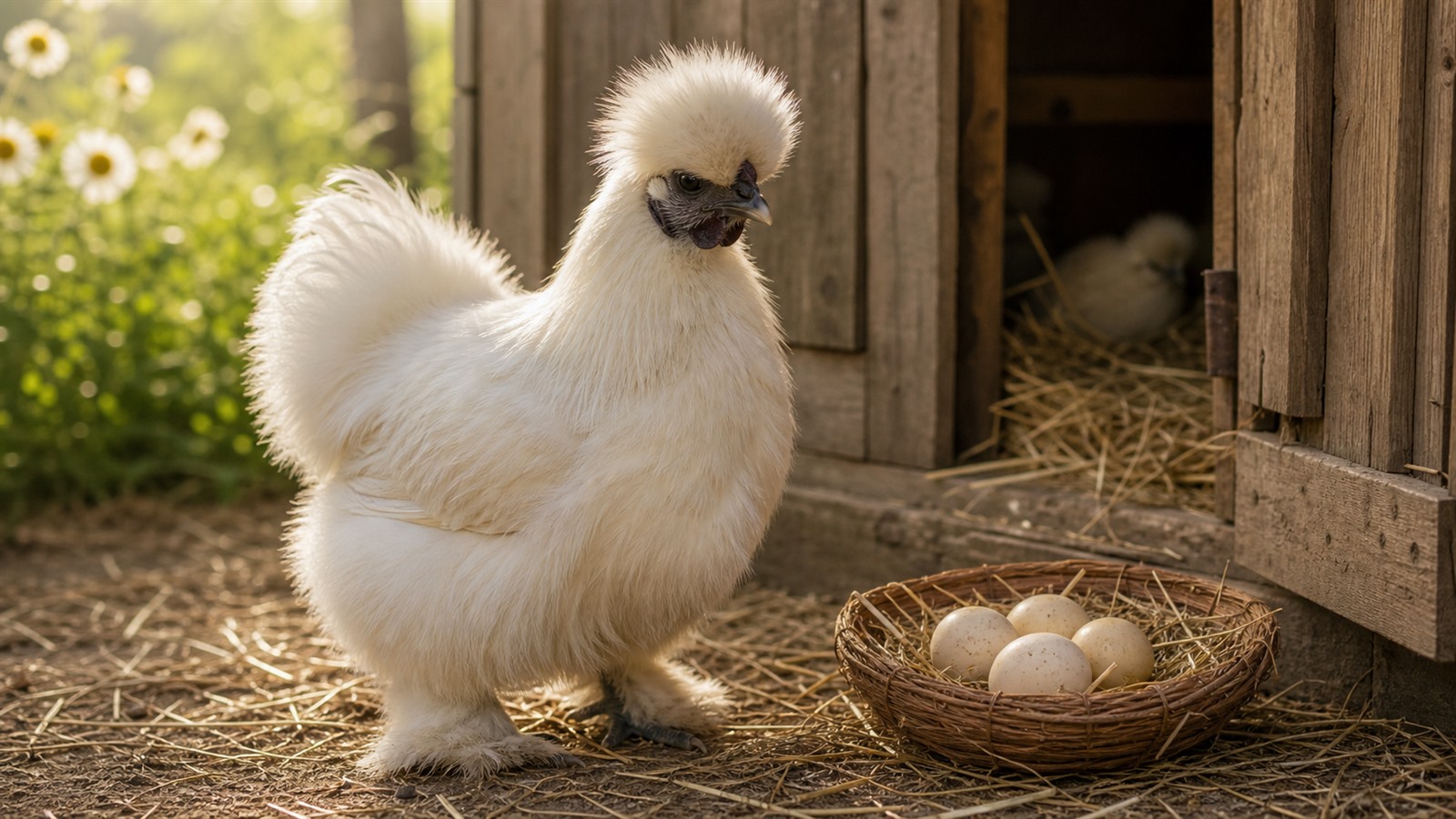
Birds handled calmly from hatch can become confident around people. They are not normally as placid as a Silkie and prefer to know where an escape route is. For a health check, close the flock into a safe smaller area rather than chasing one hen around a large garden. A long chase teaches her only that the human is slow and unpredictable.
The breed need not be aggressive in a mixed flock, although speed gives it an advantage at the feeder. A heavy slow hen may still be leaving the perch while the Italianer has taken the best pieces. Provide a long feeder or more than one feeding point. Male temperament varies between strains; a human-aggressive cock should not be retained merely for an attractive comb and colour.
Italianer egg production through the first five laying years
The first-year range of about 180-200 eggs agrees with traditional descriptions of a good Italianer. Later ranges are a practical age-related estimate, not part of an official breed standard and certainly not a sales guarantee. Exhibition-heavy strains may lay less; a carefully recorded utility family may do better. The breeder's figures for mothers and sisters are more valuable than a historic breed record copied across websites.
Most pullets begin at roughly 20-24 weeks. A late hatch, shortening days, stress, poor nutrition or illness can delay the first egg. Trying to force an immature pullet with excess energy is a mistake. She needs to build frame and reach a sound body weight before carrying the cost of production.
A sudden flock-wide decline should not be blamed on age. Check water, ration balance, parasites, moult, day length, stress and health. An economical active bird still needs enough energy and amino acids. Recording eggs by flock for several weeks gives a far more honest picture than judging performance after one good or bad day.
| Laying year | Practical egg range | What commonly changes |
|---|---|---|
| Year 1 | 180-200 | the most regular period after production settles |
| Year 2 | 160-185 | still useful, often with a slightly larger egg |
| Year 3 | 135-165 | longer recovery after moult and stronger seasonality |
| Year 4 | 105-140 | lower frequency, although a sound hen remains useful |
| Year 5 | 75-115 | large differences between strains and individual hens |
White eggs: shell colour does not decide nutritional value
Italianer eggs are white and commonly reach about 55-65 g once a hen is properly established. The first pullet eggs are smaller and should not go straight into an incubator. Breed descriptions often use roughly 55 g as a minimum hatching-egg weight. Choose eggs that are typical for the flock, clean, normally oval and free from hairline cracks.
A white shell is not nutritionally inferior. Shell pigment is mainly genetic, while freshness, feed, hen health and husbandry shape the quality of the egg. A dark shell looks striking in a basket but does not arrive with extra vitamins. In a mixed flock, the Italianer's white egg is easy to identify and helps the keeper track point of lay and broad group performance.
Broodiness is commonly lower than in Silkies and many heavy breeds, although strains vary. If natural hatching matters, ask what the actual mothers in the breeder's flock do. It is unwise to assume that no active Italianer will ever sit, but equally unwise to plan a season around every hen becoming a reliable broody.
Climate and housing: protect the large comb without sealing the coop
The breed can live successfully in cool temperate regions, but the large single comb is more exposed than a rose or pea comb. Frostbite risk rises when cold is combined with high humidity and a draught across the perch. Closing every ventilation opening is not the answer: condensation and ammonia inside a sealed coop often create worse conditions than dry cold air.
Place perches away from a direct air stream while keeping high-level ventilation open. Litter must remain dry and drinkers should not flood the floor. Protective ointment cannot compensate for a wet building. In hot weather this lighter active breed usually copes better than a heavily feathered dual-purpose bird, yet it still requires deep shade, cool drinking water and a roof that does not radiate heat into the night shelter.
Coop and run: a low fence is only a warm-up
The Italianer shows its strengths on a roomy range. A practical starting point is around 0.3-0.4 square metres of usable indoor floor per bird and at least 4 square metres of run if the ground is expected to remain functional. More area usually pays back through less mud, fewer disputes and greater natural foraging. A tiny bare pen encourages an intelligent light hen to investigate the other side of the boundary.
A fence around 1.5-1.8 metres is more realistic than low decorative netting. Some birds will stay in until they are startled or spot better ground. Predator netting overhead is ideal; otherwise remove launch points close to the fence. Wing clipping is a last resort, must be done correctly on one wing, and needs reassessment after each moult.
Allow about 22-25 cm of perch per bird so the whole flock can roost together. A stable bar around 4-5 cm wide works well. One nest for four hens is usually sufficient. Italianers are light enough to use higher perches than Australorps, but there must still be a safe approach and landing area.
Feeding: an efficient forager cannot live on whatever appears in the garden
An adult Italianer commonly eats around 105-120 g of balanced layer feed per day. The true amount depends on body size, weather, production, ration density and range quality. A skilled forager adds useful insects and plants, but grass and beetles cannot guarantee a consistent supply of protein, amino acids, calcium and vitamins for regular egg production.
Use a complete layer ration as the base, provide clean water and offer a suitable calcium source separately. Whole grain, maize, bread and household scraps are extras rather than the main diet. The breed is less prone to obesity than a heavy chicken because it moves so much, but confinement plus excessive grain can still reduce condition and laying performance.
Feel the breast rather than judging only the feathers. The keel should be detectable without feeling sharp, with muscle on both sides. A prominent keel, pale comb and sudden loss of activity need investigation. Glossy feathers do not rule out parasites or nutritional trouble, and one fashionable supplement is not a replacement for a balanced ration.
Buying Italianer stock without ending up with an undocumented cross
Look beyond the breed name in an advert. Ask for the variety, age, actual adult weights and written standard used. Find out whether the flock is maintained as German-type Italianer or Leghorn. A responsible breeder should be able to explain the distinction and show complete birds rather than only an attractive close-up of a male's head. Real laying notes and the minimum size of eggs set for hatching are useful signs of practical selection.
- request current side-on photographs of both hens and the breeding male
- check clean yellow legs, four toes, white earlobes and a single comb
- ask for measured adult weights rather than relying on the variety name
- for hatching eggs, ask about fertility in recent comparable hatches
- avoid unusually small, dirty, cracked or seriously misshapen eggs
- confirm whether colour varieties are kept separately and will breed reasonably true
- quarantine new adult birds before introducing them to the home flock
Breeding priorities: eggs, health and temperament matter alongside colour
A male's hackles and tail are easy to admire, but selection should start with feet, breastbone, breathing, temperament and family history. A breeding cock must be active without attacking people or exhausting hens. For a light breed, one male to around eight or ten hens is often workable, although a particularly vigorous young male may need a larger group to prevent feather damage.
Retain hens that lay regularly, produce well-shaped eggs, remain healthy through the season and keep a sound body condition. Colour matters beside these features, not in place of them. Selecting only one exhibition detail can gradually weaken practical performance. Breeding every bird simply because it is pure-bred preserves crooked toes, poor combs and bad temper just as effectively as it preserves a desirable colour.
Some carefully selected partridge-type lines allow an experienced breeder to make an early estimate of chick sex from down markings. That is not a universal guarantee across every strain and variety. Anyone claiming perfect sexing at hatch should be able to explain exactly which line supports that confidence.
The first month with new Italianers
A newly moved Italianer can be much more nervous than it appeared at the breeder's home. People, feed, housing and flock order have all changed. Give the bird a predictable routine and cover while observing appetite and droppings each day. Releasing an unhandled light hen directly onto a large unsecured range can turn catching her into the evening's main project.
- prepare a dry quarantine pen with separate feeder and drinker
- check weight or breast condition, legs, breathing, nostrils and external parasites
- avoid changing feed, lighting and all equipment at the same time
- secure the top of the run and remove easy launch points near fences
- after quarantine, let the two groups see one another through mesh first
- provide more than one feeding point when mixing them with slower breeds
- record first eggs, weight, moult and behaviour instead of trusting memory
Who will enjoy this breed, and who may be disappointed?
The German-type Italianer suits a keeper who enjoys active chickens, has a secure range and wants a steady supply of white eggs. It performs particularly well where birds can cover useful ground, forage and use shrubs or shelters. In a mixed-colour egg flock, the white shell also makes group identification delightfully simple.
It may disappoint someone seeking a very quiet heavy bird behind a low fence or a dependable natural broody. It is not an ideal match for a damp cramped coop with no outdoor interest. The comb deserves winter attention and flight ability deserves year-round planning. These points do not make the breed difficult; they simply show why matching a chicken to the site matters.
Before buying, ask three questions: is the run roomy and secure, do I accept a watchful independent temperament, and can I keep a winter coop dry while maintaining ventilation? Three honest yes answers make the Italianer one of the most useful and visually rewarding light breeds for a small flock.
My practical verdict
The Italianer is underestimated because it sits between categories. It cannot match the most intensive commercial hybrids, yet it lacks the fluffy outline that instantly makes an ornamental breed popular online. In an ordinary chicken yard it offers something more durable: respectable laying, economical feed use, athletic health and a strong instinct to forage.
The main mistake is buying one as merely a calmer Leghorn or calling every slim brown hen an Italianer. Check type, background and the flock's real results. A good bird should be elegant but not frail, active but manageable, productive yet recognisably true to its standard. That useful middle ground is exactly what makes the breed interesting.
Piotr Markot
poultry keeper. I keep poultry myself and write about the checks that actually help around a small coop, without pretending that every odd egg or missing feather has one magic answer.
Read next on the blog
See all guides →
FAQ
How many eggs does a German-type Italianer lay?
A useful hen commonly lays around 180-200 white eggs in her first full year. Strain, age, day length, health, nutrition and season all affect the result.
How much do Italianer hens and cocks weigh?
Hens commonly weigh about 1.75-2.5 kg and cocks about 2.25-3.0 kg. Exact ranges depend on the national standard and breeding strain.
Are Italianer and Leghorn chickens the same breed?
They share Italian ancestry and are closely related, but several European systems maintain German-type Italianer and Leghorn as separate standards. Always ask which standard the breeder follows.
What colour eggs do Italianer hens lay?
They lay white eggs, commonly around 55-65 g once established. Sound hatching eggs are usually selected at roughly 55 g or heavier.
Are Italianer chickens cold-hardy?
They can live well in a dry ventilated temperate-climate coop, but the large single comb is exposed to frostbite. Damp air and a draught across the perch increase the risk.
Can Italianer chickens fly over fences?
They are light and capable, so some birds can clear low fencing easily. A 1.5-1.8 m barrier or a roofed run is more dependable.
Do Italianer hens go broody?
Generally less often than Silkies and many heavy breeds, although broodiness varies by family. Ask about the breeder's actual hens if natural hatching matters.
Which Italianer colour is most common?
Partridge is widely recognised in Central Europe. Silver, Black, White, Blue and other varieties are also kept, with recognition depending on the national standard.
Sources behind this guide
The practical advice is checked against poultry extension and veterinary material, not just repeated from forum folklore.
Want to describe what is happening in your flock?
Tell me the birds' age, feed, housing and whether the problem affects one hen or the whole flock. The email address appears only after a click so it is not left open for simple scraping bots.
Keep the details before they disappear from memory
Twoja Farma helps you record eggs, feed changes, flock observations and costs. A short note made today is often more useful than a confident guess next week.