Green-legged Partridge chickens: the Polish breed built for free range
 Piotr Markotpoultry keeper
A practical guide to Poland's Green-legged Partridge
Piotr Markotpoultry keeper
A practical guide to Poland's Green-legged Partridge
Updated:
The Green-legged Partridge is not a production hybrid wearing a heritage label. It is an old Polish landrace shaped by farmyards where chickens were expected to range, forage, return to the coop and raise chicks without constant fuss. Give it space and it becomes a sharp, useful, fascinating bird. Shut it in a bare little pen and most of its best qualities turn into frustration.
Where did this breed originate?
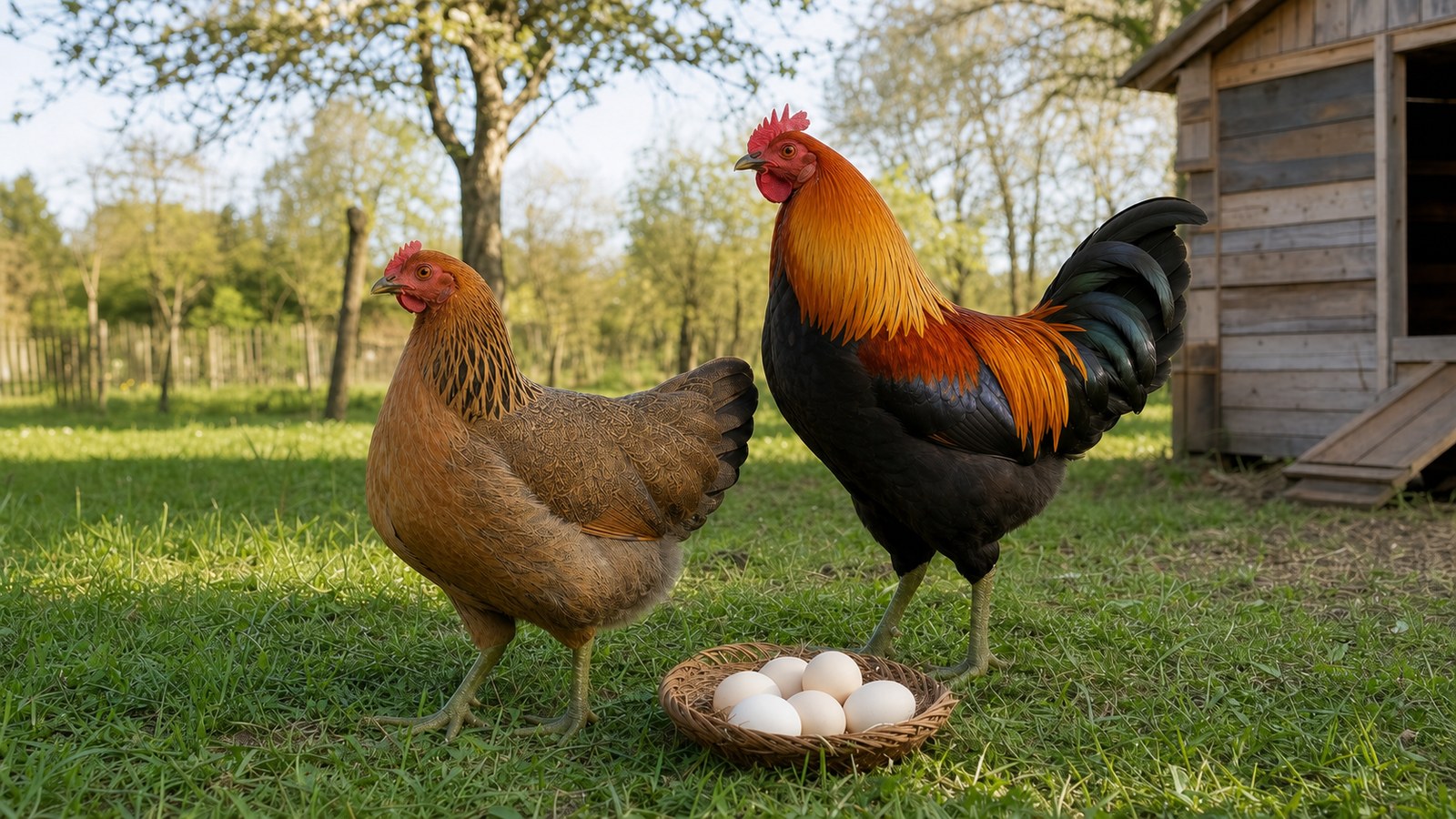
The Green-legged Partridge is a native Polish breed identified in the late nineteenth century from farm chickens. Its preserved lines are now included in genetic conservation programmes. The green legs are a useful clue, but documented parentage matters when buying birds for purebred breeding.
The name creates one predictable misunderstanding: the legs are green, not the eggs. Hens lay white to cream-coloured eggs. If a seller promises green shells, they are confusing the breed with blue-egg or olive-egg genetics.
This guide is written for keepers outside Poland as well as Polish breeders. Availability varies enormously by country, so I cover not only laying and housing but also how to verify stock, why genuine conservation lines matter and when another locally established breed may be the more sensible choice.
Printable Green-legged Partridge breed card
Adult weights, eggs, temperament, housing needs and realistic laying ranges are gathered on one clear A4 page.
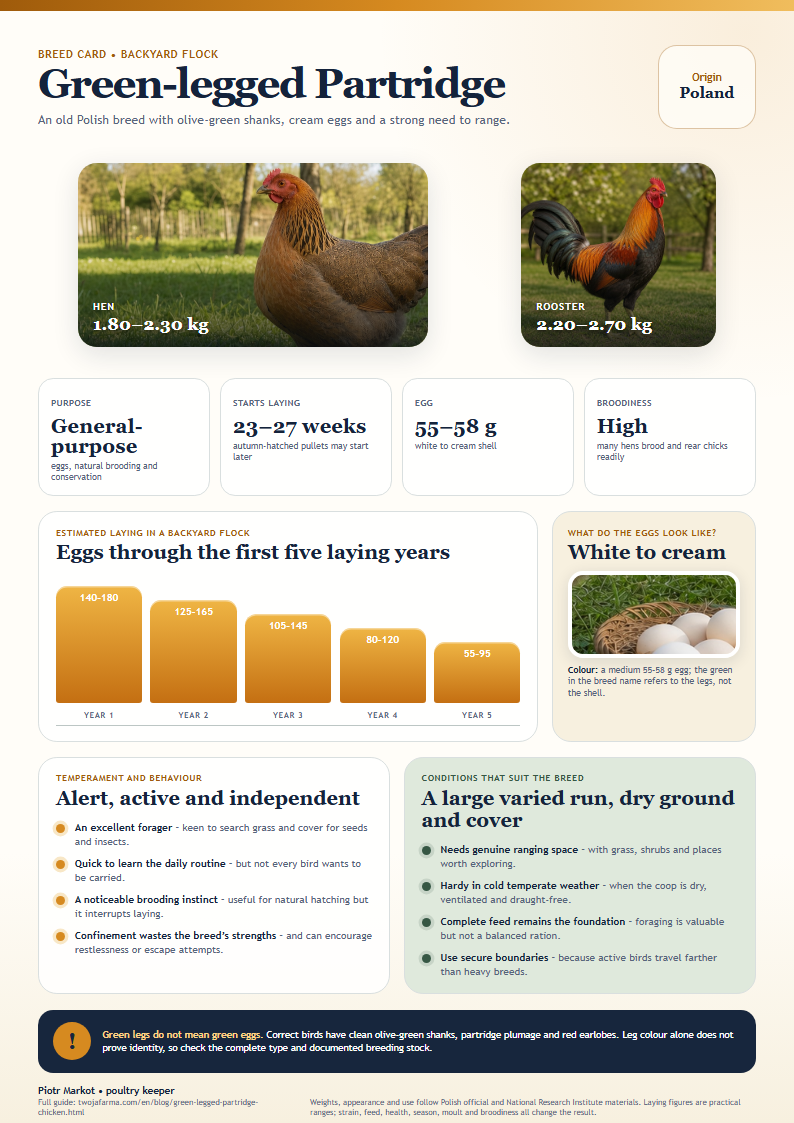
The breed in five honest points
- an old Polish breed maintained within genetic-resource conservation programmes
- an active forager that needs a generous, interesting run
- roughly 140-180 white or cream eggs in a strong early laying year
- alert, independent and often willing to brood and rear chicks
- a poor match for intensive confinement or a tiny barren backyard pen
Key breed facts
| Trait | Practical range | What it means |
|---|---|---|
| Hen weight | about 1.8-2.3 kg | light to medium and agile on range |
| Rooster weight | about 2.2-2.7 kg | athletic rather than heavy |
| First eggs | usually 23-27 weeks | late-season pullets may take longer |
| Egg weight | commonly 55-58 g | pullet eggs begin smaller |
| Shell colour | white to cream | green legs do not produce green eggs |
A Polish landrace with a real history
The breed developed from the farm chickens of historic Galicia in southern Poland. Those birds were not selected in a climate-controlled unit. They survived by using pasture efficiently, noticing danger, coping with cold seasons and reproducing reliably in small farm flocks. That background still shows in the modern breed's movement, caution and strong interest in foraging.
Poland includes Green-legged Partridge populations in its farm-animal genetic-resource protection work. This is more than a romantic heritage story. A small conserved population can lose type quickly when birds are crossed carelessly, so traceable breeding stock matters if you want the actual breed rather than a green-legged backyard mix.
What a true Green-legged Partridge looks like
The hen carries partridge plumage: a salmon or warm brown breast, grey-hazel wings and darker pencilling through the neck feathers. She is medium-sized, relatively light and built to move. The clean, unfeathered shanks are olive or willow green. The comb is single, facial skin and earlobes are red, and the iris is orange.
The rooster is far more dramatic, with orange-gold hackles and saddle, a black breast and belly, dark wings and a black tail showing green sheen. His shanks should also be clean and greenish. Green legs alone do not prove purity; many crosses can inherit a similar shade, so body type, plumage and provenance belong in the same assessment.
Cream eggs, not green eggs - and no miracle-health promise
Mature hens usually lay white, ivory or cream eggs around 55-58 grams. Early pullet eggs are smaller and then increase as the bird settles into lay. The breed name refers to the colour of the shanks, so it should never be sold as a green-egg breed.
You may also see strong claims about cholesterol or uniquely healthy eggs. Research does identify differences between breeds and rearing systems, but an egg's composition is influenced by feed, age, season and access to range. I would buy this breed for its heritage, behaviour and useful eggs, not because a sales advert turns an ordinary food into a medical product.
Temperament: clever, watchful and rarely lazy
These chickens are busy. They scan the ground, move between cover and can travel much farther from the coop than a heavy placid breed. On a secure smallholding this is exactly what makes them enjoyable. Near a road, loose dogs or weak fencing, the same independence creates work.
They are not normally human-aggressive, but not every bird wants to be carried. Consistent calm handling helps. In mixed flocks they usually suit other active standard-sized breeds. Watch feeders if they live with very slow, crested or bantam birds, because a quick landrace can arrive first every time without appearing overtly aggressive.
Why range is a need rather than a bonus
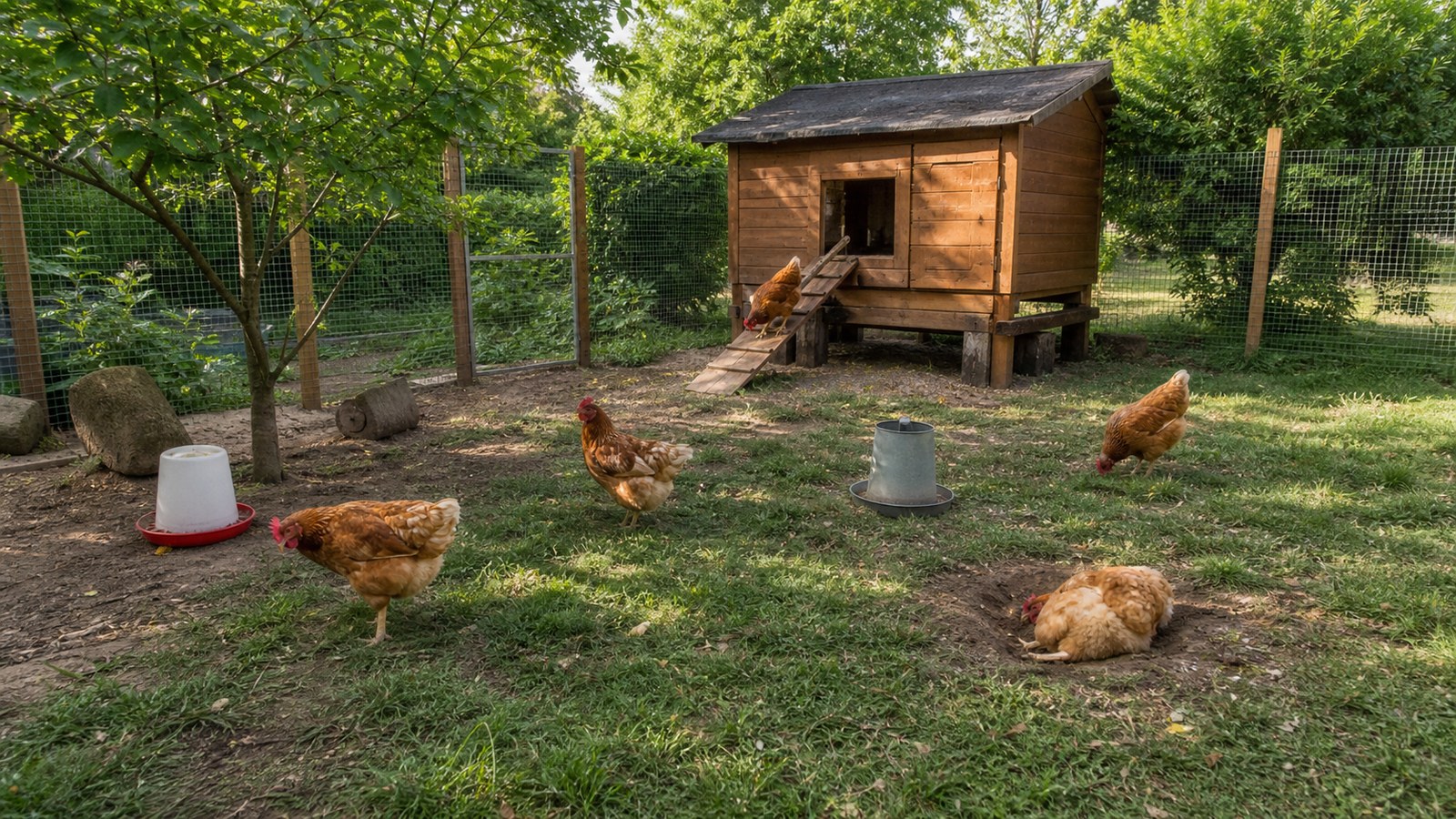
If I could choose only one requirement for this breed, it would be usable outdoor space. A token strip of bare soil beside the pop hole is not enough. Green-legged Partridge hens want to scratch through grass, leaves and shrubs, hunt insects and keep moving. A varied run turns their energy into normal behaviour.
A cramped, empty pen increases the chance of pacing, feather pecking, arguments and escape attempts. Shrubs, visual barriers, branches, dry dust-bathing areas and several feeding points help. In wetter climates, rotating sections of the run or covering a high-traffic zone prevents the whole area becoming mud.
Cold, rain and summer heat in different countries
The breed is well adapted to a temperate Polish climate and usually handles dry cold sensibly. That does not make damp bedding, ammonia or draughts acceptable. A dry coop with ventilation above roost level matters more than heating. A rooster's single comb can still suffer frost damage when cold is combined with moisture.
In hotter parts of the United States, southern Europe or Australia, heat becomes the bigger limitation. Deep shade, multiple cool-water points and airflow are essential. This is a Polish ranging breed, not a reason to ignore local climate. If your summers are extreme, plan the shaded run before buying birds rather than improvising during the first heatwave.
Feed: good foraging does not replace a complete ration
Their ability to find greens and invertebrates is useful, but it should never become an excuse to underfeed. The base still needs to be a complete ration appropriate to age and laying stage, with clean water and free-choice calcium for layers. Foraged food adds variety, activity and some nutrients; it is not a measured balanced diet.
The contribution from range changes dramatically between a lush spring and a cold wet winter. If laying, body condition or shell quality slips, first check the main feed, water access, parasites and health. Throwing random supplements at the flock while the ration is weak only makes the cause harder to identify.
Broodiness and natural chick rearing
Many hens retain a useful maternal instinct and will sit or rear chicks. That is an advantage for keepers who value natural incubation. It is also time away from laying, a nest occupied for weeks and a management job if other hens keep adding eggs beneath the broody.
Individual variation is real. Do not order an entire breeding plan around the assumption that every hen will brood on schedule. Record which birds settle well, leave the nest to eat, protect chicks without panic and return to lay in good condition. Those notes are more useful than a general breed reputation.
Buying genuine birds outside Poland
In countries where the breed is rare, the hardest part may be finding legal, unrelated and correctly identified stock. Ask for the origin of the line, photographs of adult breeding birds, hatch records and honest information about how many families are being maintained. Import rules for hatching eggs and live poultry vary, so check your national animal-health authority before money changes hands.
A crossbred hen can be healthy and delightful, but it should not be marketed at a heritage-breed price. If conservation is your aim, pedigree and population diversity matter. If you simply want an energetic free-range layer, a locally available landrace may be easier to source responsibly and will often be better adapted to your climate.
Who should keep them - and who should choose something else
The breed suits a keeper with an orchard, paddock or generous secure run who enjoys natural chicken behaviour and accepts seasonal laying. It can be a brilliant addition to a small conservation-minded flock, especially when the owner wants birds that forage, brood and remain visibly different from commercial hybrids.
I would not choose it for a tiny urban pen, an unfenced property exposed to predators or a household demanding maximum large eggs every week of the year. Green-legged Partridge chickens are good at being themselves. The mistake is buying them and then removing the space, movement and choice that made the breed valuable in the first place.
Piotr Markot
poultry keeper. I keep poultry and judge a breed by more than a catalogue egg number. The first question is whether the bird fits the space and routine we can genuinely provide.
Sources and breed data
Breed history, production traits and appearance were checked against Polish government, National Research Institute of Animal Production and agricultural education materials.
Green-legged Partridge FAQ
Do Green-legged Partridge hens lay green eggs?
No. Their shanks are olive green, while the eggs are white, ivory or cream.
How many eggs do they lay each year?
A young hen commonly produces about 140-180 eggs in a good season. Broodiness, winter, moult and management change the total.
Are they suitable for a small backyard?
Only if the backyard includes a generous, interesting and secure run. They are a poor fit for a tiny barren pen.
Are they cold hardy?
They generally handle temperate cold well in a dry ventilated coop, although a rooster's single comb still needs protection from damp frost.
How can I identify genuine stock?
Look at the full breed type, partridge plumage, clean olive-green legs and documented origin. Green legs alone are not proof.
Keeping this breed or trying to locate it?
You can tell me about your climate, run size and what you expect from the flock. The address is revealed only after a click so it is less exposed to basic email-scraping bots.
Track eggs, broody spells and individual hens
Twoja Farma lets you record breeds, flocks, egg collections, hatches and observations. Over time you can see which hens actually perform and cope best in your own setup.