Australorp chickens: egg production, size and why people like them
 Piotr Markotpoultry breederFor practical backyard flocks
Updated:
If you want a breed that feels steady, useful and not overly complicated, Australorp often lands high on the list. People know it for strong laying ability, calm behaviour and a body size that still feels useful in a dual-purpose flock.
Where did this breed originate?
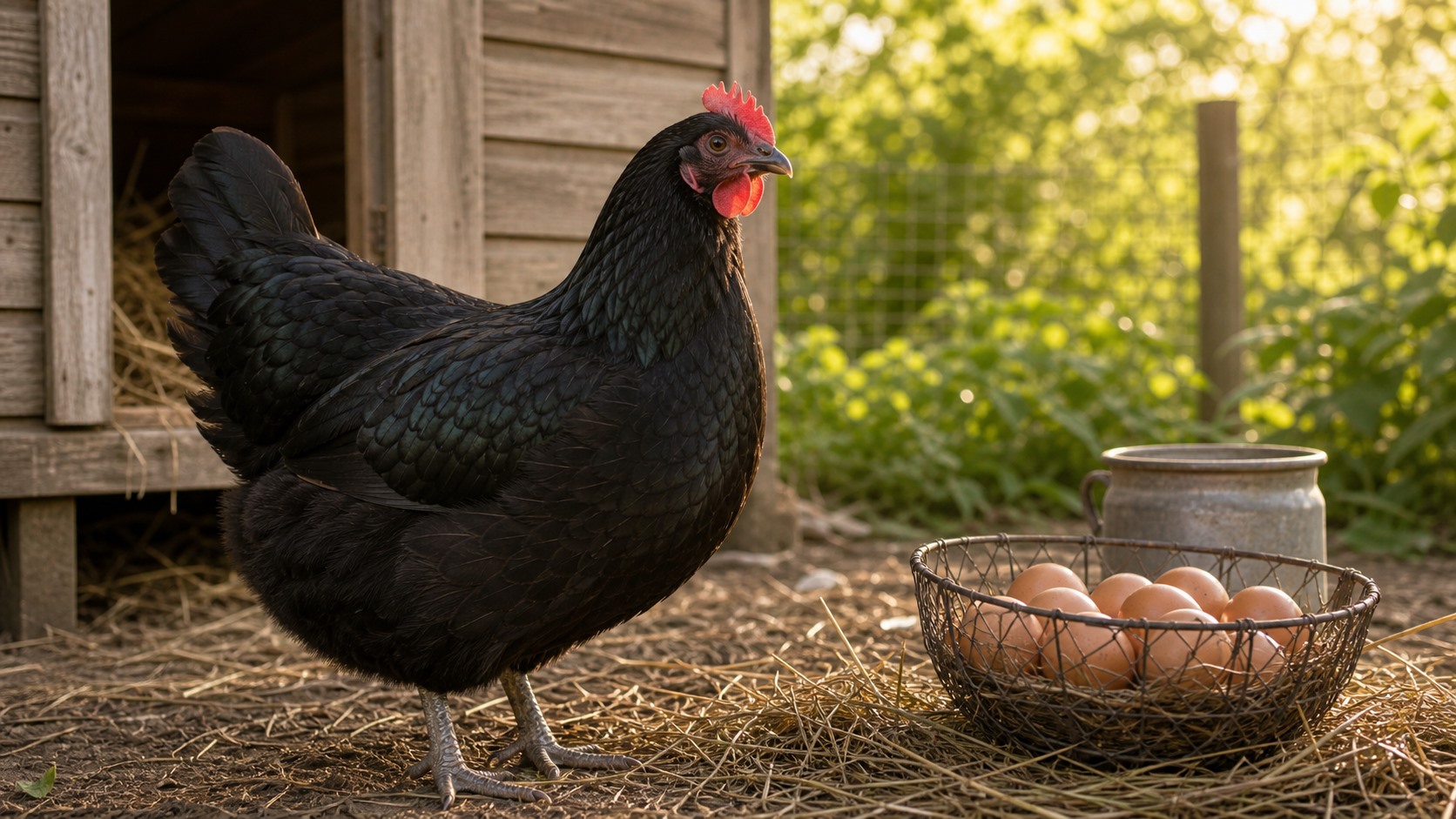
Australorps were developed in Australia from Black Orpingtons imported from England. Australian breeders placed particular emphasis on egg production. That shared ancestry does not make Australorp and Orpington interchangeable breed names; check the identity and breeding records of the flock you are buying from.
It is not a flashy novelty breed. That is exactly why many keepers like it.
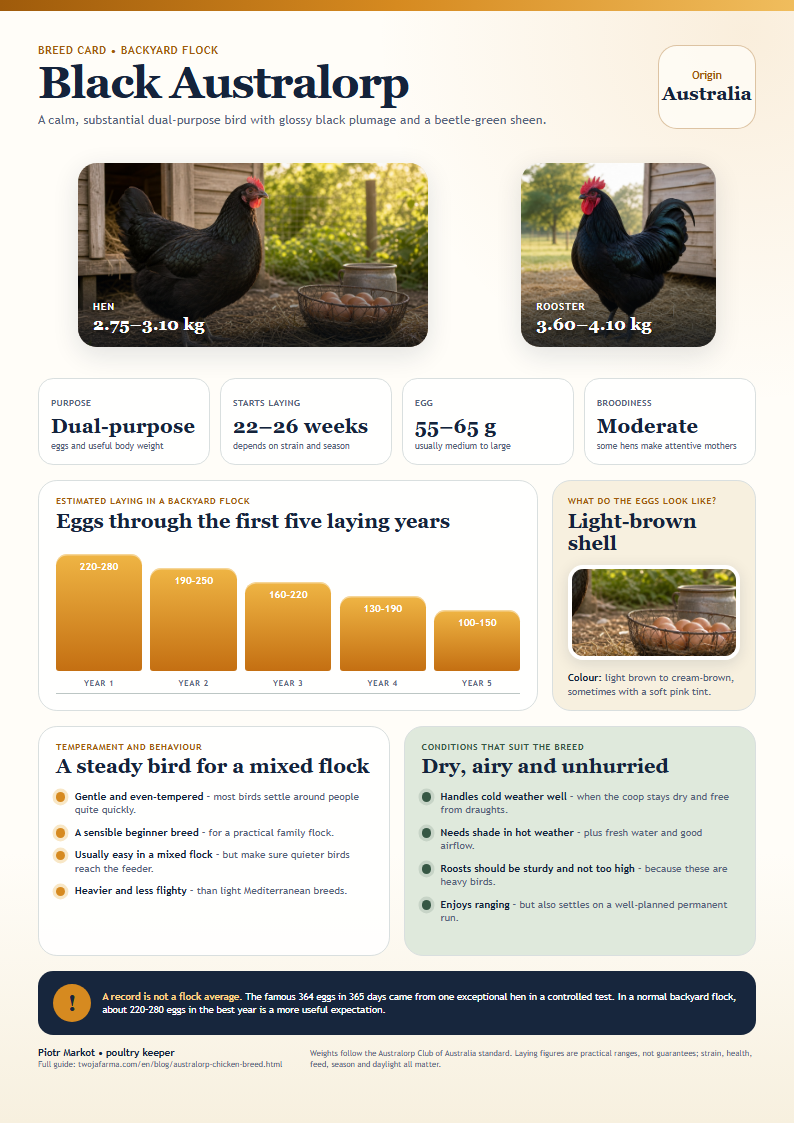
Printable Black Australorp breed card
Keep the key figures for adult weight, eggs, temperament and housing on one clear A4 page.
Short version: why Australorps earn their reputation
- big strength: strong all-round balance,
- they often feel steadier than lighter, more reactive layers,
- they bring both usefulness and presence to a flock,
- they usually fit temperate backyard conditions well if the coop is dry and sensible.
What really makes Australorps different
Australorps are not exciting because they are rare or flashy. They are exciting because they are dependable in a way many backyard keepers grow to value more and more. They often feel like honest working hens: enough egg production to be worthwhile, enough size to feel substantial, and enough calm to make day-to-day flock life easier.
That kind of balance is easy to underestimate until you have lived with birds that are either more nervous, more fragile, or much less rounded in what they offer.
Expected laying from year 1 to year 5
Australorps can lay very well, but like every breed, they change with age. The most helpful way to think about them is not as a fixed number, but as a strong early performer that usually remains useful through later years.
| Laying year | Practical backyard range |
|---|---|
| Year 1 | Often around 200 to 250 eggs in a solid first full season. |
| Year 2 | Usually around 180 to 230 eggs, still strong for a backyard hen. |
| Year 3 | Often around 150 to 205 eggs. |
| Year 4 | Commonly around 120 to 175 eggs. |
| Year 5 | Often around 90 to 140 eggs, while still remaining useful hens in many flocks. |
Those are realistic backyard ranges, not catalogue promises. Poultry Hub Australia advises backyard keepers not to expect more than roughly 250 eggs a year, and line quality, molt, climate and management can move the result lower.
Why they can suit backyard keepers better than some other breeds
The key word here is balance. Australorps often make more sense than lighter, more restless birds if you want a flock that feels stable and easy to live with. They also make more sense than purely ornamental breeds if you still want real practical output from the feed you are paying for.
That is why so many keepers recommend them even when they are not chasing breed novelty.
Useful husbandry tips for real-world conditions
Australorps usually do well in cooler, wetter climates when the coop stays dry and ventilation makes sense. They do not need special pampering, but like any good bird they stop looking impressive quickly if they are kept in wet litter, poor airflow or too much crowding.
They can also work well as a stabilising breed in mixed flocks because they often bring a calmer feel than more reactive hens do.
Would I recommend them?
Yes, very easily, especially for people who want a practical breed without fuss. Australorps are not just good on paper. They often become the kind of hens people quietly trust more with every season.
What I would ask before buying Australorps
Before buying Australorps, I would ask more than “how many eggs do they lay?”. I would ask about adult weight, temperament, winter laying, parent stock and whether the birds have been selected for a solid body as well as production. A good Australorp should feel like a balanced utility bird, not a nervous lightweight layer painted black.
For a backyard flock, calm behavior is a big part of the value. If the birds are steady, easy to handle and keep condition well, they are often more useful than a line that promises big egg numbers but falls apart under normal small-flock conditions.
For planning a new Australorp flock, I also use the practical chart showing when different breeds usually lay their first egg.
Australorp size, body type and the difference between strains
A mature Australorp should look like a substantial utility chicken, not a narrow black layer. Exact standards differ slightly by country and strain, but large-fowl hens commonly sit around 5.5 to 7 pounds (2.5 to 3.2 kg), while mature males are often around 7 to 9 pounds (3.2 to 4.1 kg). A young pullet will obviously feel lighter, so compare birds of the same age rather than rejecting a growing bird for not having an adult body yet.
There is also a real difference between exhibition lines, utility lines and hatchery stock. A show-focused bird may have impressive depth and feather quality but modest laying. A utility line may be selected harder for eggs. Neither is automatically wrong; trouble starts when the seller promises the body of one and the output of the other without records.
In North America black is the best-known recognised variety, while other countries and local standards may include colours such as blue or white. Colour alone does not make a bird productive. When I compare lines, I put health, width of body, sound legs and actual laying history before the novelty of the plumage.
Why two Australorp flocks can give very different egg numbers
The famous historical laying record helped build the Australorp name, but it should not be turned into a promise for every hen sold today. Day length, molt, heat, body condition, diet and genetics all change the annual total. A hen that starts late in autumn may look disappointing on a calendar even though her first full laying season is strong.
I judge a small flock by more than one busy spring month. I record the first egg, winter pauses, molt and any broody spell. Then I compare hens from the same line under the same conditions. That tells me much more than a hatchery maximum printed without context.
Large brown eggs, steady production and longevity are a more useful goal than chasing one spectacular number. If shells become thin or body condition drops while output stays high, the flock is not really winning.
Cold, rain and summer heat
Australorps generally handle cool conditions well when the coop is dry, ventilated and free from a direct draft at roost height. Their single comb still needs watching in severe frost. Damp air and condensation are the enemy: sealing every vent to “keep them warm” often creates a worse environment than the cold itself.
Black plumage absorbs heat, so summer deserves equal attention. Deep shade, cool water in more than one place and airflow matter. Heavy birds do not need to be chased across a hot yard. Panting, wings held away from the body and a sudden drop in feed intake mean the setup needs changing now, not after the weather forecast improves.
A buying checklist that is more useful than asking for a record
- Ask for the age and adult weight of the parent stock.
- Ask when pullets from the line normally begin laying and how they perform after molt.
- Look for straight toes, clean breathing, bright eyes and a broad, balanced body.
- Find out whether the seller selects for eggs, exhibition type or both.
- If buying hatching eggs, ask about fertility and the age of the breeding pen, not only shell colour.
My favourite question is simple: “What is the weak point of this line?” A serious breeder usually has an answer. Someone selling perfect birds with perfect laying and no trade-offs is selling a story rather than a flock.
Piotr Markot
Poultry breeder. I write practical notes from everyday small-flock keeping, without making the topic more complicated than it needs to be.
FAQ
Are Australorps good layers?
Yes. Their reputation is built on being strong practical layers, especially in the earlier seasons.
How heavy are Australorp hens?
Many mature hens fall roughly around 2.7 to 3.2 kg, though strain and condition matter.
Are Australorps calm?
Often yes. Calm temperament is one of the reasons backyard keepers like them.
Are Australorps better than lighter hybrids?
Not automatically better, but often more balanced if you want useful body size as well as good laying.
What this article is based on
Still have a question?
If you want to ask whether Australorps fit your flock or how they compare with another breed, you can write to me by email.