Wyandotte chickens: eggs, temperament, size and colour varieties
 Piotr Markotpoultry keeperFor backyard keepers and small flocks
Updated:
A Wyandotte can look ready for a poultry show while digging up an ordinary muddy corner of the run. Here is what the breed offers once you look beyond the spectacular laced feathers.
Where did this breed originate?
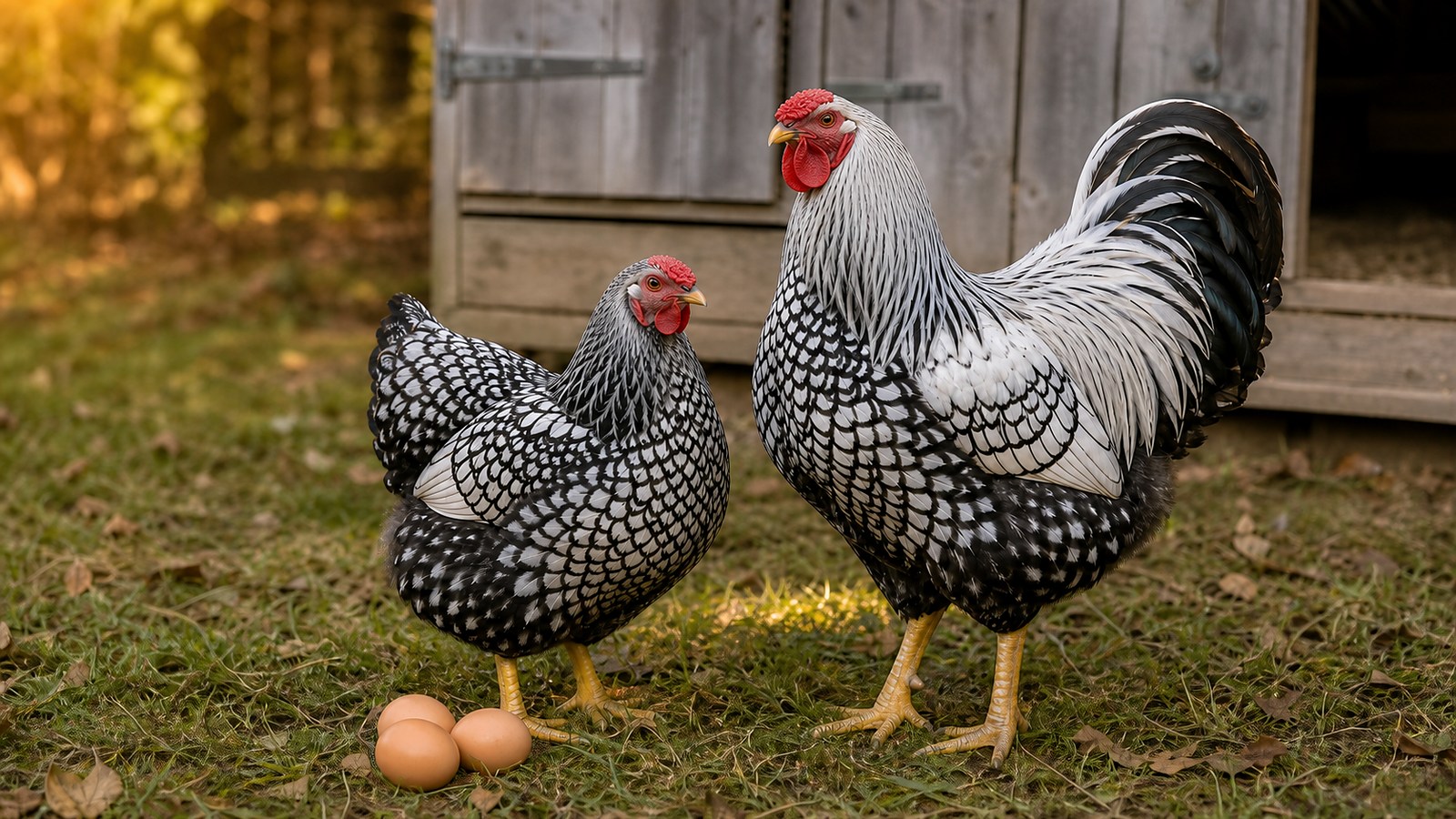
The Wyandotte was developed in the United States in the second half of the nineteenth century as a dual-purpose chicken. Silver Laced was the first recognised variety. Modern colour choices are much wider, but a striking feather pattern should never replace checking body shape and soundness.
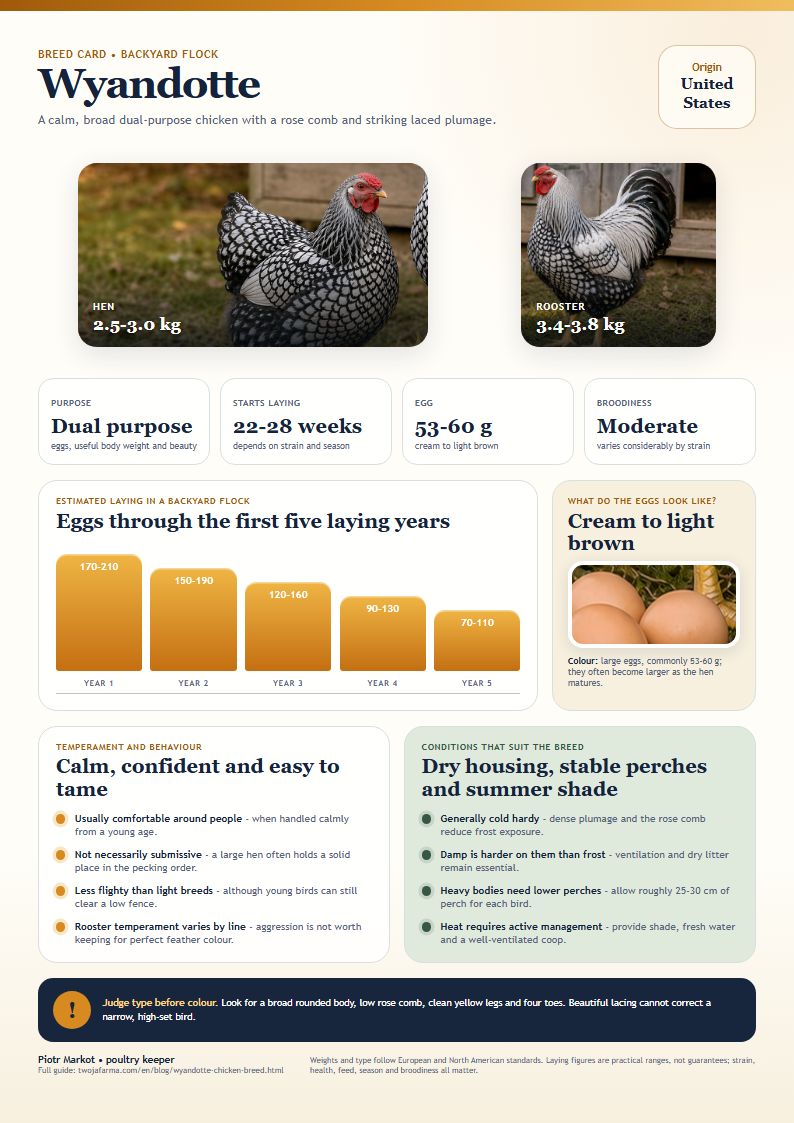
Printable Wyandotte breed card
Adult weights, eggs, temperament, housing needs and realistic laying ranges are gathered on one clear A4 page.
The short answer: beautiful, steady and useful, but not a high-output laying hybrid
A Wyandotte makes an impression before anybody counts an egg. The broad rounded body, low rose comb and neatly edged feathers give even an ordinary walk across the run a touch of a poultry show. Under that decorative plumage, however, is a practical dual-purpose chicken: usually calm, cold-hardy and productive enough for a household flock.
It is not the breed for someone expecting hybrid-layer numbers on the least possible feed. A useful strain may produce roughly 170-210 eggs in its first full laying year, while an exhibition strain, repeated broodiness, excessive heat, obesity or short winter days can reduce that total. In return you get a substantial bird that remains attractive for years, carries useful body weight and is normally much easier to handle than a nervous light breed.
My one-line verdict is simple. Choose Wyandottes when appearance, temperament, resilience and brown eggs all matter. If the only target is the cheapest possible egg, a selected laying strain will win. If the pleasure and stability of a backyard flock matter as well, the Wyandotte has a stronger case than its showy feathers first suggest.
Wyandotte facts: adult weight, eggs and working traits
National standards do not all use identical weights. North American references commonly list 6.5 lb for a hen and 8.5 lb for a cock, about 2.95 and 3.86 kg. Several European standards give approximately 2.5-3.0 kg for hens and 3.4-3.8 kg for males. That is not a reason to distrust every figure; it is a reason to ask which standard and which size a breeder actually keeps.
| Trait | Practical range | What it means in a backyard flock |
|---|---|---|
| Hen weight | about 2.5-3.0 kg | large fowl; use broad, stable and fairly low perches |
| Rooster weight | about 3.4-3.9 kg | allow extra feeder room and avoid very high roosts |
| Start of lay | usually 22-28 weeks | later than an early hybrid; autumn-reared pullets may take longer |
| Eggs | cream to light brown | often 53-60 g, becoming larger as the hen matures |
| First full year | roughly 170-210 eggs | strain, feed, daylight, health and broodiness all matter |
| Temperament | calm and self-assured | easy to tame but rarely the most submissive bird in the flock |
| Comb | rose comb | less exposed to frost than a tall single comb |
| Purpose | dual-purpose | a balanced combination of eggs, body, looks and longevity |
Where the breed came from and why Silver Laced remains the reference variety
The Wyandotte was developed in the United States during the second half of the nineteenth century. Silver Laced was the first variety admitted to the American Standard of Perfection in 1883. The birds had previously been known as American Sebrights before the Wyandotte name was adopted. Their exact ancestry is debated, with Dark Brahma, Silver Spangled Hamburg and Sebright among the breeds frequently mentioned.
The breeding goal was practical. Family farms needed a bird with enough body for the table, a useful supply of brown eggs and the constitution to handle hard northern winters. Appearance later became equally important, and the clean black edge around each silver feather turned the Wyandotte into one of the most recognisable exhibition chickens in the world.
Silver Laced is still the clearest variety for understanding correct Wyandotte type. The white centre of each feather should be enclosed by a defined black border, producing an orderly pattern over a broad curved body. It should look like consistent lacing rather than random spotting. A good pattern is impressive, but it should never replace body shape, sound legs or health in a breeding decision.
How to recognise a true large-fowl Wyandotte
Look at shape before colour. A Wyandotte should be broad, deep and distinctly rounded, with a medium-length back that rises gently towards the tail and a full breast. The tail should not resemble the narrow upright fan of a light Mediterranean layer. Plumage lies fairly close while still giving a smooth, generously curved outline. Shanks are clean, yellow and unfeathered, with four toes.
The second giveaway is the rose comb. It is low, broad and finely textured, finishing in a spike that follows the line of the head. A tall serrated single comb is not correct breed type. Face, wattles and earlobes are red; eyes are commonly reddish bay to orange-red, and the skin is yellow.
Young birds have not filled out completely, but you can still assess body width, leg set, comb type and clean shanks. A very narrow, tall bird may carry attractive lacing without developing the substantial Wyandotte body. When breed accuracy matters, current photographs of both parents tell you more than the prettiest close-up of one chick.
Colour varieties: silver, gold, blue and many more
Silver Laced and Gold Laced are the best-known varieties. Depending on the national standard, you may also meet Blue Laced Red, White, Black, Blue, Buff, Partridge, Silver Pencilled, Barred and Columbian birds. Recognised lists differ between countries. A colour accepted in one show system may be non-standard or described differently in another.
Colour must not hide poor type. Precise lacing cannot repair a narrow breast, excessive leg length or an incorrect comb. The reverse is also worth remembering: a useful backyard hen with imperfect markings can still be a healthy, genuine Wyandotte. The buyer simply needs to decide whether the goal is home production, a breeding project or exhibition competition.
Bantam Wyandottes are especially widespread in parts of Europe. They are not undersized large-fowl chicks but a separate developed form with its own weights and standard. Always ask whether hatching eggs or chicks come from large fowl or bantams. The answer changes adult size, egg size, space planning and which birds can sensibly share a breeding pen.
Temperament: calm does not always mean bottom of the pecking order
Most Wyandottes are steady around people and quickly associate a keeper with food. They are less reactive than many light breeds and are not usually determined escape artists. Birds handled quietly from a young age can be examined, weighed and moved without turning every health check into a chase around the garden.
A calm Wyandotte is not necessarily submissive. A broad three-kilogram hen often holds a middle or high position in a mixed flock and can displace a small Silkie or a young pullet from a single feeder without looking openly aggressive. When sizes differ, provide at least two feeding and drinking points and observe the flock after the morning rush as well as during it.
Roosters are often composed, but temperament belongs to the strain and individual, not to a guaranteed label attached to the breed name. I would not keep a human-aggressive male for breeding merely because his lacing is excellent. In a family breed, manageable behaviour is a production trait, not a cosmetic extra.
How many eggs a Wyandotte may lay over five years
These are working estimates for healthy large fowl from a strain that retains utility. They are not a breed-standard promise. An exhibition line may lay less, as may a hen that repeatedly goes broody. A carefully selected utility strain can exceed the upper range in its first season. The most useful question for a breeder is not the internet record but the actual annual figures kept for the parent flock.
Age-related decline is normal. Older hens often lay larger eggs less frequently and take longer to restart after moult. A sudden flock-wide collapse should not be blamed on birthdays alone. Check water, complete feed, parasites, body condition, daylight, stress and health in a sensible order.
Wyandottes may continue better through cool weather than some delicate breeds, but they do not promise an egg every day of winter. Short days and moult still affect them. Extending day length is a management decision, not a requirement; many backyard keepers reasonably allow an annual rest.
| Laying year | Estimated eggs | What commonly changes |
|---|---|---|
| Year 1 | 170-210 | best regularity once the pullet settles into full lay |
| Year 2 | 150-190 | still a useful result in a healthy productive strain |
| Year 3 | 120-160 | longer seasonal pauses and a slower return after moult |
| Year 4 | 90-130 | larger eggs but a clearly lower frequency |
| Year 5 | 70-110 | considerable variation between individual hens |
Egg colour, egg size and broodiness
Wyandotte eggs range from cream and warm beige to light brown. Do not expect a Marans chocolate shell or an Araucana blue. Pullets begin with smaller eggs and many mature hens settle around 53-60 g. North American breed guides describe the eggs as large and brown, while European minimum hatching-egg weights vary with the variety and standard being used.
Broodiness is moderate and highly strain-dependent. Some hens never consider sitting, while another may settle firmly once a clutch appears. Their body size and steady nature can make good mothers, although a heavy hen may crack very small or fragile eggs in a cramped, slippery nest.
If egg supply is the priority, every broody period reduces the annual total and should be included in expectations. If natural incubation is wanted, use a quiet hen in sound condition and give her a separate low nest. Constantly moving a broody bird or allowing other hens to add eggs each day is a quick way to turn a simple hatch into confusion.
Climate and housing: cold tolerance does not remove the need for dry air
The compact body, dense plumage and low rose comb make Wyandottes particularly useful in cool temperate regions. They do not need a sealed heated coop. Dry litter, ventilation above bird level and freedom from a direct draught across the roost matter much more than raising the indoor temperature.
Wet thawing weather can be harder than a clean dry frost. Mud, damp feathers and condensation inside an over-sealed house undermine the breed's reputation for hardiness. Build a covered section of run, stabilise the busiest gateways and keep the drinker area from becoming a permanent swamp.
Heat is the other side of the equation. A broad, densely feathered bird loses heat less easily than a light breed. In a hot spell provide deep shade, several sources of cool water and real air movement through the house. Open-mouth panting and wings held away from the body mean the decorative plumage has become a thermal burden.
Coop space, run, perches and nest boxes for a heavier bird
Allow more room than you would for a small layer. In a backyard flock, around 0.4-0.5 m² of genuinely usable indoor floor space per large Wyandotte and at least 4 m² of outdoor ground are comfortable planning figures when the run is expected to stay functional. They are practical targets rather than universal legal minima. Climate, drainage, flock temperament and the number of hours spent indoors can justify more.
Give roughly 25-30 cm of perch length per bird. The perch should be stable, about 4-6 cm wide and lower than one designed for a nimble light breed, because repeated heavy landings strain feet and keel bones. A nest around 35 x 35 cm is comfortable. One box for four hens is normally enough even though the flock may still vote unanimously for the same one.
Wyandottes are not famous fliers, yet young birds can clear a casual boundary. A fence around 1.5 m works better than a token low net. Include shelters and visual breaks in the run so a lower-ranking hen can step out of sight instead of being followed across an empty rectangle.
Feeding without turning a rounded breed into an overweight one
A large chicken eats more than a bantam, but appetite is not a reason to offer unlimited maize. An adult Wyandotte commonly consumes around 115-130 g of complete feed a day, depending on size, temperature, range and diet energy. Grain, scraps and treats should remain a small addition because they dilute the protein, vitamins and minerals required for eggs and healthy muscle.
Rounded plumage can make every bird look well covered, so assess body condition with your hands. The keel should be easy to find without feeling knife-sharp, with muscle alongside rather than a thick pad of fat. Obesity reduces heat tolerance, can lower laying performance and contributes to reproductive problems. Extra grain in winter does not replace a balanced ration.
Laying hens need access to calcium, ideally offered separately as oyster shell or suitable coarse limestone, as well as clean water. Insoluble grit is needed when birds consume whole grain and forage. No single supplement should become the automatic answer to every shell problem.
Buying hatching eggs, chicks or point-of-lay pullets
A good breeder does not need a studio-quality sales page, but should answer ordinary questions. Ask for the variety, large-fowl or bantam type, breeding standard, parent age and weight, egg colour and approximate flock performance. Also ask whether colour varieties run in separate pens and how long the line has been maintained.
- request current full-body photographs of the hen and rooster, not only a close-up feather
- check for a low rose comb, yellow clean legs and four toes
- confirm whether the offer is large-fowl Wyandotte or bantam Wyandotte
- for hatching eggs, ask about parent age and recent fertility rather than a historical best result
- do not expect every chick to develop perfect lacing because both parents look attractive
- avoid birds with respiratory noise, dirty nostrils, twisted toes or raised leg scales
- quarantine every new bird before it joins the resident flock
Breeding colour varieties without losing the breed underneath
When a recognisable variety is the goal, mating sound birds of the same well-managed colour is the simplest route. Crossing Silver Laced with Gold Laced may produce interesting offspring, but it does not create two clean show varieties in one convenient hatch. Silver is sex-linked and the finished pattern depends on several additional genes plus generations of selection.
Blue follows incomplete dominance. From blue x blue, a large sample is expected to average around 25% black, 50% blue and 25% splash offspring. That is a probability across numbers, not a guarantee from six eggs. Blue Laced Red also requires selection for the red ground colour and a clear, even edge.
Do not select on feather colour alone. Body width, rose comb, legs, health, fertility, growth, laying history and behaviour belong in the breeding decision. A line chosen only for spectacular lacing can become late-maturing and unproductive while still looking excellent in photographs.
A sensible first month with new Wyandottes
Most avoidable trouble begins when a new bird is dropped straight into an unfamiliar flock, receives different feed, sleeps in a new building and is caught repeatedly for photographs on the same afternoon. A quiet predictable start shows you the bird's real temperament and makes an early health problem easier to spot.
- prepare a dry quarantine pen with separate feed and water before the birds arrive
- weigh each bird or at least record a body-condition baseline
- avoid changing feed, lighting and all equipment at the same time
- observe droppings, breathing, appetite, leg scales and behaviour at different times of day
- introduce groups through a secure mesh barrier before full physical contact
- use two feeders and drinkers when large Wyandottes join much smaller hens
- record first eggs, broodiness, weight and moult so future breeding choices use evidence rather than memory
Who will enjoy this breed, and who may be disappointed
Wyandottes suit keepers who want calm, impressive chickens with respectable egg production and enough room for large fowl. They fit a family smallholding, a mixed basket of egg colours and a careful colour-breeding project. The rose comb and substantial build are particularly useful where winters are cold.
They may disappoint anyone measuring success only in eggs, relying on a tiny flat-pack coop or keeping birds through prolonged extreme heat without shade and ventilation. Large Wyandottes occupy more real space than a product label often allows. Exhibition strains can also be less productive than a generic breed description implies.
The best purchase begins with a clear purpose. Know the size, standard and line you are buying. Then you will not expect record egg numbers, perfect exhibition markings, guaranteed broodiness and minimal feed consumption from the same hen. The Wyandotte succeeds because it balances several qualities rather than maximising one.
My practical conclusion
The Wyandotte does not need invented claims. It is substantial, steady, hardy, capable of a useful supply of tinted eggs and available in colours that make an ordinary flock memorable. The essential choices are a sound strain, dry housing and feed management that prevents obesity.
For a small flock I would choose it ahead of a beautiful but nervous or fragile breed. Not because it wins every egg-production table, but because it can remain a healthy, predictable and enjoyable bird to work with over several seasons.
Piotr Markot
poultry keeper. I keep poultry myself and write about the checks that actually help around a small coop, without pretending that every odd egg or missing feather has one magic answer.
Read next on the blog
See all guides →
FAQ
How many eggs does a Wyandotte lay each year?
A useful large-fowl strain may produce roughly 170-210 eggs in the first full laying year. Exhibition breeding, broodiness, season, health and feeding can move the result substantially.
What colour eggs do Wyandottes lay?
Usually cream, tinted beige or light brown eggs. They are not blue and should not be expected to match the dark shell of a well-selected Marans.
How much does an adult Wyandotte weigh?
European large-fowl hens commonly weigh about 2.5-3.0 kg and males 3.4-3.8 kg. North American standard weights are around 6.5 lb for hens and 8.5 lb for cocks.
Are Wyandotte chickens cold-hardy?
Yes. Dense feathering and a low rose comb suit cool climates, but the coop must still remain dry and ventilated without a direct draught over the roost.
Are Wyandottes aggressive?
They are usually calm with people, although their size often gives them a confident place in the pecking order. Small gentle breeds need enough feeder and drinker access.
Do Wyandotte hens go broody?
Some strains go broody readily and make good mothers, while others rarely sit. Broodiness should be checked in the breeder's actual line rather than assumed from the breed name.
Are large-fowl and bantam Wyandottes the same size?
No. They are separate forms with different standard weights and egg sizes. Always confirm which type is being offered before buying eggs or chicks.
Which Wyandotte colour is the original?
Silver Laced was the first recognised variety and remains the most recognisable. Gold Laced, Blue Laced Red and Columbian are also widely kept, depending on country.
Sources behind this guide
The practical advice is checked against poultry extension and veterinary material, not just repeated from forum folklore.
Want to describe what is happening in your flock?
Tell me the birds' age, feed, housing and whether the problem affects one hen or the whole flock. The email address appears only after a click so it is not left open for simple scraping bots.
Keep the details before they disappear from memory
Twoja Farma helps you record eggs, feed changes, flock observations and costs. A short note made today is often more useful than a confident guess next week.