Best feed for laying hens: what actually matters
 Piotr Markotpoultry breederFor everyday egg production
Feed is one of those topics that gets complicated very quickly, even when the real answer is often fairly basic. In most small flocks, the goal is not to build a perfect theoretical ration from scratch. The goal is to keep hens laying well, holding condition and producing decent shells without chaos.
What a good layer feed really has to do
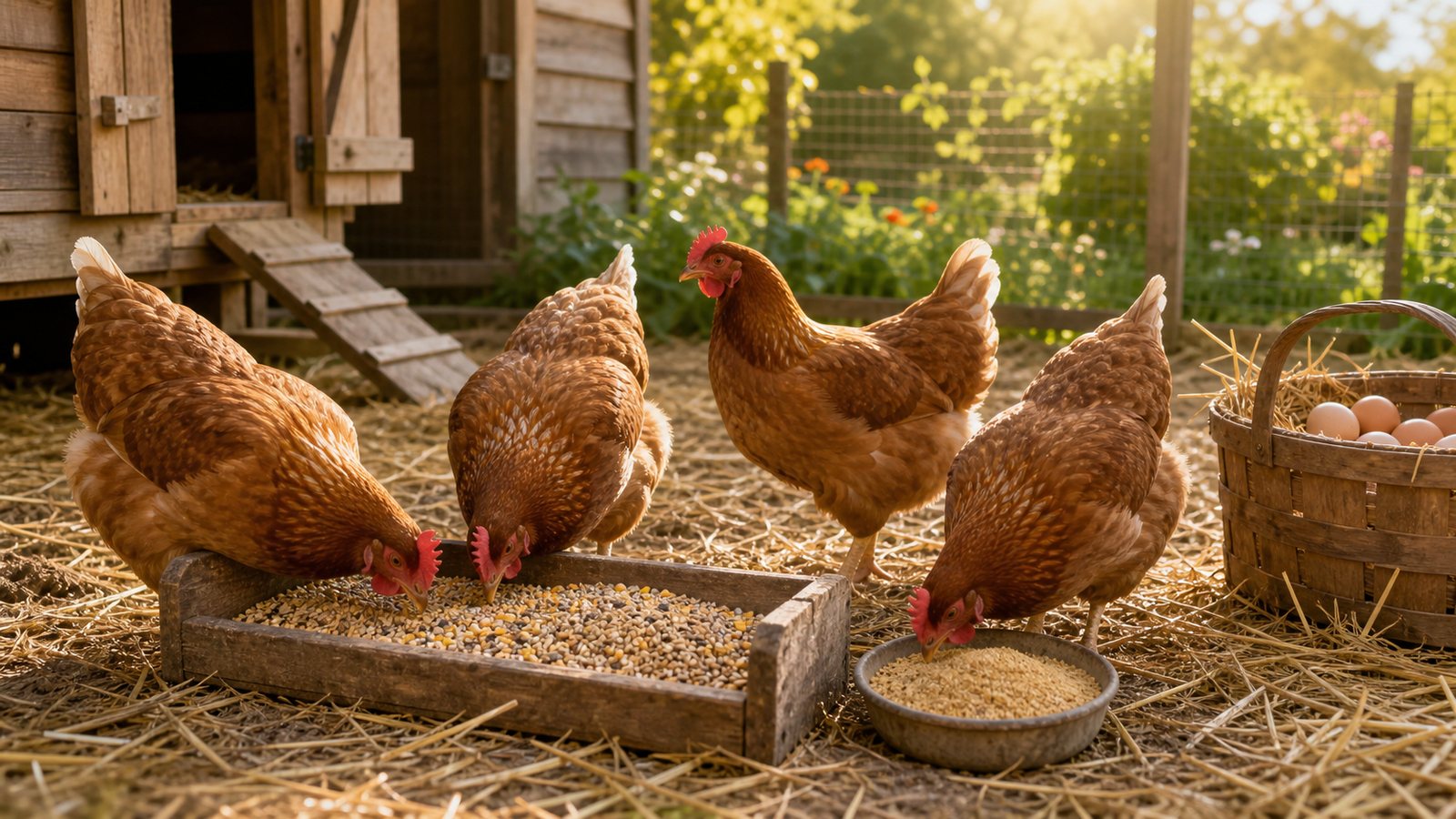
In a backyard flock, the best feed is not the one with the fanciest label. It is the one that helps hens keep laying steadily, hold body condition and produce decent shells without turning daily feeding into guesswork.
That means the ration has to cover energy, protein and shell support at the same time. If one part drops behind, the flock usually tells you through thinner shells, weaker laying rhythm or hens that simply do not look as strong as they should.
What matters more than marketing words
For most backyard keepers, the real questions are practical ones. Are the hens keeping condition? Are the shells staying strong? Does the flock eat well and lay steadily? Those are better signals than chasing every fashionable ingredient that appears in a product description.
That is why I would rather judge a feed by how hens perform on it over time than by how dramatic the packaging sounds on day one.
Commercial feed, grain mixes and home-made rations
| Approach | Main strength | Main risk |
|---|---|---|
| Complete layer feed | Simple, consistent and easy to use every day. | Quality still varies, and some keepers assume every complete feed works equally well. |
| Grain-heavy feeding | Feels natural and can be attractive in a mixed feeding routine. | Can drift away from balanced laying nutrition if it becomes the main diet. |
| Home-made ration | Flexibility and local sourcing. | Easy to underdo minerals, protein balance or shell support if the ration is built too casually. |
What I would watch in my own flock
I would watch shell quality first, then egg size consistency, then overall body condition. Those three signals usually tell you whether the flock is being fed well. If shells weaken, hens feel light, or laying drifts more than expected, the feed plan deserves a hard look before you start blaming everything else.
I would also pay attention to waste. Feed that sounds premium but gets flicked out, sorted through or ignored is not automatically a better choice just because the ingredients read nicely.
When a home-mixed ration can work, and when it becomes risky
A careful home mix can work in the hands of someone who understands what the hens still need beyond simple grain. But this is exactly where many small flocks go wrong. People build a beautiful-looking mix from local cereals and extras, then discover shell quality falling because the complete mineral balance never really existed.
So yes, a home mix can be part of a good system. But it should be built with more discipline than "a bit of this and a bit of that".
My practical recommendation
If you want the simplest stable result, choose a sensible complete layer feed as the base, then keep extras under control. If you enjoy home-mixing, do it with open eyes and keep checking how shells, body condition and laying rhythm respond over time.
How I would test a new layer feed
I would change feed calmly and watch for at least a couple of weeks. The first days only show whether hens like the feed. The more useful signs come later: shell strength, laying rhythm, body condition, droppings and whether the flock eats evenly instead of picking only the tastiest parts.
Do not change feed, calcium, housing and supplements all at once. If everything changes together, you will never know what helped. A simple feed test works best when the rest of the routine stays boring and predictable.
A workable 25 kg home mix for laying hens
A bucket of wheat and maize is not a layer ration. This batch keeps cereals for energy, then brings in soybean meal and peas for protein, two calcium particle sizes and one carefully measured balancer.
It is meant for healthy adult hens already in lay. It is not chick, pullet or broiler feed. Pasture can contribute insects and greens, but its nutrient supply changes with the season and cannot replace a measured vitamin-mineral source.
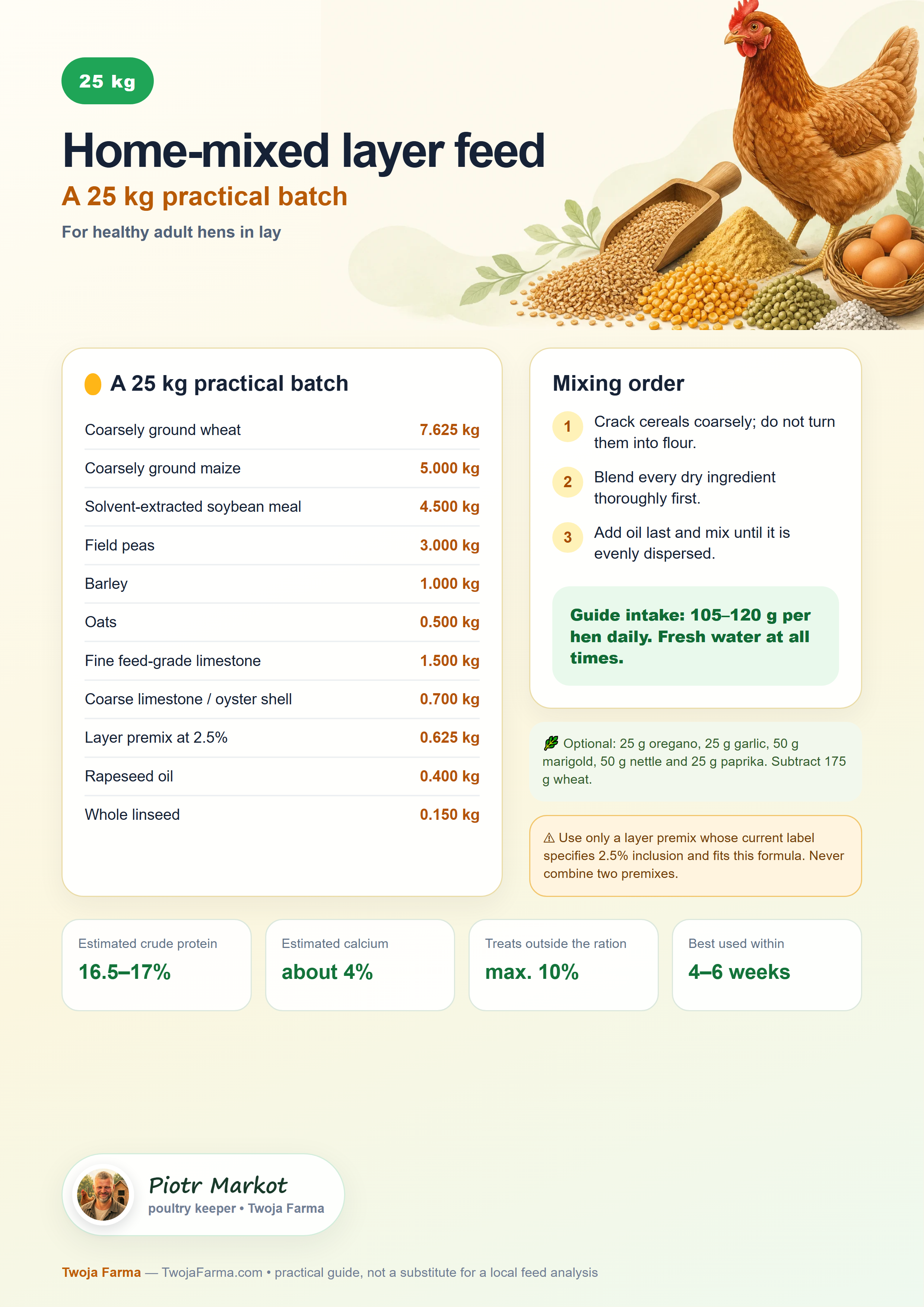
The 25 kg formula
| Ingredient | 25 kg |
|---|---|
| Coarsely ground wheat | 7.625 kg |
| Coarsely ground maize | 5.000 kg |
| Solvent-extracted soybean meal | 4.500 kg |
| Field peas | 3.000 kg |
| Barley | 1.000 kg |
| Oats | 0.500 kg |
| Fine feed-grade limestone | 1.500 kg |
| Coarse limestone or oyster shell | 0.700 kg |
| Layer premix used at 2.5% | 0.625 kg |
| Rapeseed oil | 0.400 kg |
| Linseed | 0.150 kg |
The batch totals exactly 25 kg. With ordinary ingredient values it lands around 16.5–17% crude protein and roughly 4% calcium; actual figures move with crop and supplier.
Why the protein source matters
Peas are useful, but peas and cereals alone tend to leave a hard-working layer short of essential amino acids. Soybean meal lifts protein and lysine; the chosen layer premix must also supply the amino acids, phosphorus, sodium, trace minerals and vitamins claimed on its label.
Do not add salt or a second premix by eye. A balancer is concentrated, and doubling it is not a shortcut to better laying. Oyster shell is a calcium source; insoluble granite grit has a different job and does not replace it.
Herbs are optional, not the foundation
For one batch you may use 25 g oregano, 25 g granulated garlic, 50 g marigold, 50 g nettle and 25 g paprika. Subtract the same 175 g from the wheat. These additions may change aroma and yolk colour, but they do not replace a premix or veterinary treatment.
The label decides whether this formula is usable
Premixes sold in different countries are not interchangeable. Use this table only when the current label calls for a 2.5% inclusion rate and its technical sheet fits a home-mixed layer ration. If the label says 0.5%, 1%, 5% or recommends adding phosphate, salt or limestone separately, the whole formula needs recalculating.
A mixing order that avoids concentrated pockets
- Crack the cereals and peas to a coarse meal rather than fine flour.
- Make a small pre-blend: mix the premix into several kilograms of soybean meal before it reaches the full batch.
- Add fine limestone and the coarser calcium particles, then blend until the colour and texture are even.
- Drizzle in rapeseed oil last while the mixer is running.
Feeding and checking the flock
Start around 105–120 g per adult hen per day, adjusting for body size, egg output, weather and wastage. In warm weather, feed during the cooler hours and protect water from heating up.
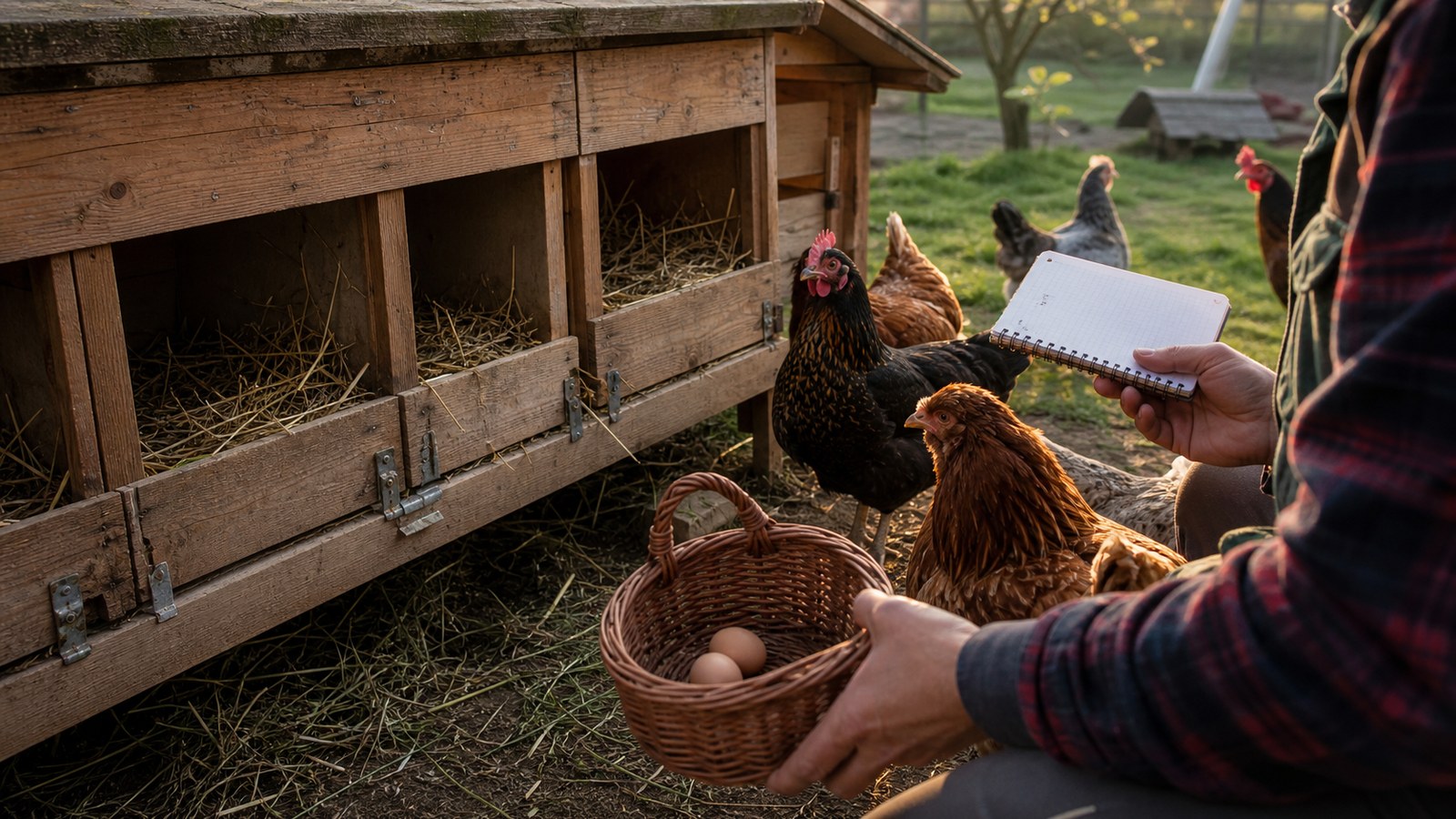
For two weeks, record feed offered, leftovers, eggs, egg weight and shell quality. Keep scraps and extra grain below about 10% of total intake or they will dilute the balanced part of the ration. Store the batch dry and use it within 4–6 weeks.
Download the printable A4 recipe
Save the card on your phone or print it beside the feed bin. The listed quantities total 25 kg.
How the targets were checked
Protein, calcium and intake ranges were checked against current Hy-Line Brown and Lohmann Brown nutrition guides. Local ingredient analysis and the actual premix label still take priority.
Piotr Markot
Poultry breeder. I write practical notes from everyday small-flock keeping, without making the topic more complicated than it needs to be.

FAQ
What matters most in feed for laying hens?
Steady support for laying, shell strength and overall body condition.
Can hens live mainly on mixed grain?
They can eat it, but grain on its own often falls short of a complete laying diet.
Is a home-made ration always better?
No. It can be good, but only when it is properly balanced instead of assembled casually.
How do I know the feed plan is not working well?
Weak shells, slipping condition and uneven laying are some of the clearest early signs.
Still have a question?
If you want to ask whether a feed plan makes sense for your hens or whether a home mix is balanced enough, you can write to me by email.